
It’s the End of the World as We Know It?: An Examination of Motives Behind Recent Funding Cuts to Development Assistance and Hierarchy in the International System
Anna Zivkovich
/
Abstract
Recent wide-scale funding cuts to development-centred foreign aid, concentrated among the Global North, have incited growing concerns that the current postnational liberal world order is nearing its end. This paper examines whether this diagnosis is true. Utilising Börzel and Zürn’s (2021) framework of contestations and McKeil’s (2020) conceptualisation of international disorder, it examines possible methods of challenging the world order and just how damaging such objections may be. It does so by conducting a secondary data analysis of primarily the United States’ Trump Administration’s cuts in 2025. It concludes that the US’s recent actions are reform contestations, as it wields its strong influence granted by its hegemonic position to reject the intrusive usage of liberal authority. This rejection has caused disorder in the world hierarchy, as it has raised questions about the foundational values of the order, while also leaving massive funding gaps, particularly felt by numerous countries in the Global South that have come to depend on such aid. This paper aims to provide clarity in a time of uncertainty, while also placing such destabilisations into a larger context.obic claims.
Introduction
An alarming amount of funding cuts to development-centered foreign aid was observed in 2025 and has continued thus far in 2026. This trend is concentrated among countries in the Global North, with the four major Organization for Economic Co- operation and Development (OECD) donors all having cut official development assistance (ODA) in 2024, a cutting only expected to increase through the end of the decade (OECDa, 2025). This comes at a time when the need for such aid is only increasing as humanitarian crises continue and escalate. Additionally, these decreases in funding have been accompanied by several dismantlings of and withdrawals from various multilateral institutions. Multilateral and internationally coordinated foreign aid is a key component of the current liberal world hierarchy (Sharman, 2013; Zhang, 2023; Bermeo, 2017). Many deem the United States of America (US) as a hegemon in this hierarchy due to its ‘outsized relative power’ (McKeil, 2020, p. 209; Mbah et al., 2025; Watson & Burles, 2018). This paper analyzes the US’ possible decline as a result of its recent cuts to development assistance funding, which will serve as the main evidence in this paper. It is important to note the distinction between development assistance and ODA, as ODA is the OECD’s official metric of development assistance. Therefore, not all evidence discussed today will fall into the subcategory of ODA, leaving ‘development assistance’ the more appropriate variable. Due to the US’s outsized influence, these actions have caused widespread negative effects throughout the hierarchy, bringing into question the structure itself. Many other countries in the Global North are following suit,1 leaving numerous states in the Global South—that have become dependent on this development assistance—in an increasingly vulnerable situation. This paper examines the effect of the contemporary liberal world hierarchy as a structure on these cuts and withdrawals. It also conceptualises the hierarchy itself as a continuous practice (Michalski, Brommesson, & Ekengren, 2024).
A wavering confidence in the current liberal world hierarchy as an effective and suitable structure has led to widespread disruptions to the system. One symptom of this is an alarming decrease in multilateral development-centred foreign aid in recent years. This paper first conducts a review of the relevant literature, establishing the concept and characteristics of the current hierarchy and its evolution, as well as the place of development assistance in such hierarchy. It then examines and synthesizes two theoretical approaches which inform the analysis: Börzel and Zürn’s (2021) framework of contestations and McKeil’s (2020) analytical conceptualization of disorder. Drawing on these theories, this paper then conducts an observational analysis of the US’ recent dismantling of its development assistance as a case study, chosen due to its previously stated outsized influence. The analysis focuses on the US Agency for International Development (USAID), the proposed FY 2026 budget, and various presidential actions. Following this examination, the US’s recent actions concerning international development aid are decisively categorised as contestational and disorderly. They directly challenge the values of the current world order—rules- based, an open pursuit of liberal social purpose, and authority placed behind the nation-state—creating instability and uncertainty (Börzel & Zürn, 2021; McKeil, 2020).
Literature Review
The current global hierarchy can be definitively categorised as liberal. Börzel and Zürn (2021) label this period as Liberal International Order (LIO) II, distinctive due to its postnational liberalism. LIO II is characterized as rules-based and openly pursuing a global liberal social purpose, with authority placed behind the nation-state and legitimacy gained from nation-state alignment with liberal values. LIO II came into being in the late 1990s, after the end of the Cold War. Development assistance and the institutions that facilitate it are an integral part of LIO II, with Non-Governmental Organizations (NGOs) becoming power brokers alongside governments during this wave of democratization (Chaudry, 2025; Sharman, 2013). However, with this pursuance comes an intrusiveness that Börzel and Zürn (2021) argue has led to an observable variety of contestations. They define contestations as “discursive and behavioral practices that challenge the authority of international institutions, their liberal intrusiveness, or the LIO as a whole” (Börzel & Zürn, 2021, p. 288). Contestations can take a variety of forms, as they are inherently reactionary to exactly what they are contesting. Examples include rises in authoritarian and populist parties, the Second Gulf War, and growing non-Western blocks such as BRICS.
Many scholars conceptualise the current global hierarchy as a structure of relationships that requires practice to maintain (Michalski, Brommesson, & Ekengren, 2024; Sharman, 2013). Sharman (2013) critiques the view of hierarchy as contractual relationships between independent actors, instead emphasising the importance of social logics. Michalski, Brommesson, and Ekengren (2024) agree in this sense, examining the importance of status-related roles – inferring hierarchy, patterns of behavior, and conforming to norms in the upkeep of the international system. However, they acknowledge that the global hierarchy is currently weakened by ‘heightened geopolitics’ that cause interactions between states to become competitive, closing the avenue of integration into the rules-based order for emerging powers (2024, p. 143). Zhang (2023) observes that their security environment directly impacts foreign aid as a component of security cooperation. He finds that when the environment becomes competitive, donors tend to, in fact, increase their foreign aid budgets, measured by ODA, and decrease when their security environment is favorable. It therefore warrants critical scrutiny as to why, in this supposedly competitive security environment, a significant number of countries have decreased their ODA.
Returning to the concept of norms, various authors observe how norms, as a basis for the current global hierarchy, can be easily exploited. Coen (2021) examines how withdrawals from refugee protection can be partially explained by international refugee regimes’ reliance on norms, and thus how obligations can be easily evaded. Kent (2023) additionally examines similar patterns, positing that after contestations of the international refugee regime, rhetorically liberal states have failed to implement the necessary practices.
Thus, the current global hierarchy’s foundation of norms guiding practice and maintenance lends it a weakness that challengers are currently exploiting. Sharman (2013) notes the role of development assistance in such norms explicitly, arguing that states, as “survivors from a previous era of imperial hierarchy”, are able to adopt an identity of “good international citizens” by conforming to such normative values (p. 29, 28). However, they are able to maintain such hierarchical ties and the benefits of subordinating other states through development assistance. International institutions, such as those used in facilitating development assistance, serve as a key component of the hierarchy as more dominant states have used them to spread liberal norms and “achieve their security and foreign policy objectives” (Zhang, 2023, p. 876). Thus, the current contestations of development assistance are examined as challenges to the current global hierarchy.
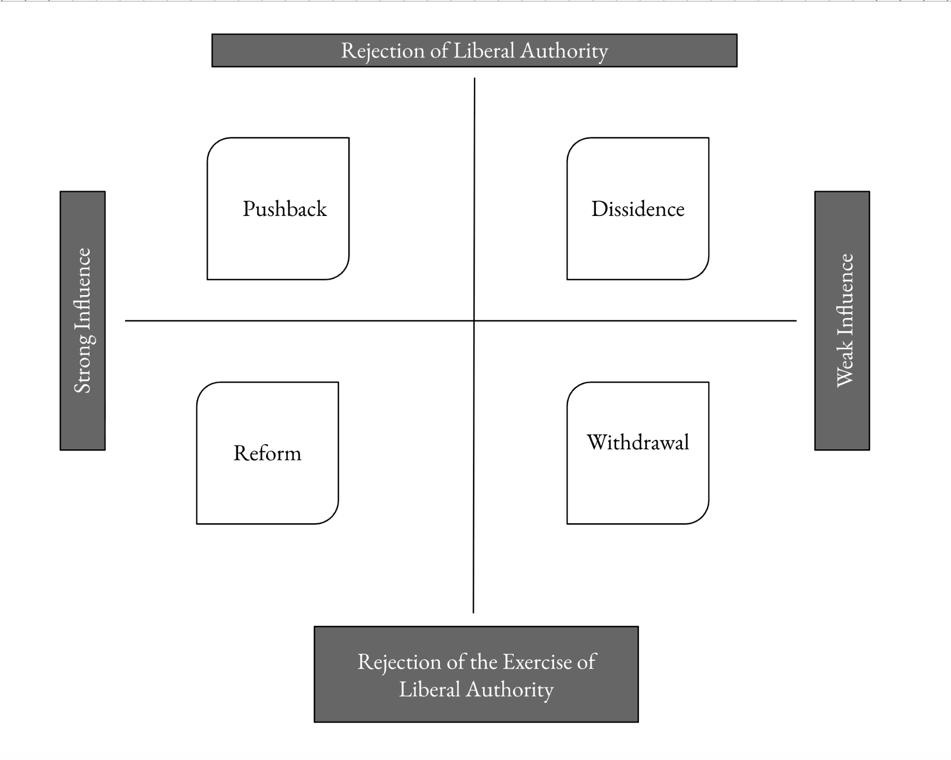
Figure 1: Varieties of Contestations (Borzel & Zurn, 2021, p.289)
Theoretical Framework
This paper will synthesise two frameworks developed by academics: Börzel & Zürn’s (2021) framework of LIO II contestations and McKeil’s (2020) concept of international disorder as an analytical tool.
Börzel & Zürn’s (2021) framework relies on the idea that growing intrusiveness causes growing contestation. Crises serve to make the presence of possibly intrusive external authority more visible, and thus increasingly able and more likely to be challenged. By intrusiveness, they mean LIO II’s push for any states involved to value the hierarchy’s own universal liberal ideas over their popular sovereignty, exacerbated by the LIO II’s growing authority being concentrated in the most dominant countries (the P5) through formalised institutional rules such as veto power (Börzel & Zürn, 2021). Thus, they categorise contestations on an axis of contestants’ degree of institutional influence and their preferences regarding the LIO II – a spectrum of whether they have a problem with a specific exercise of liberal authority to the mere existence of liberal international authority (Börzel & Zürn, 2021, p. 288-289). On this axis – as visualized in Figure 1 – Börzel and Zürn (2021) label the four contestation strategies as: pushback, dissidence, reform, and withdrawal. This paper will categorise the US’ recent actions according to this framework.
This paper also places the US’ recent development aid policies in the framework of international disorder. McKeil (2020) makes the important distinction that international disorder has previously been viewed as alarmist, vague, and purely normative; he develops it for an analytical usage. He defines international disorder as “the disruption of ordering international behaviour, rules and norms, producing a condition of instability and unpredictability in international affairs.” (2020, 203). He does note that this definition is still partly normative due to the component of stability or the disruption of such; however, he justifies its inclusion by stating that international orders do appear to want to produce a condition of international stability. After this disruption and instability, however, there may then be a process of ‘reordering’ the global hierarchy into a new, stable existence. The next section will show that it currently appears that we are in the phase of international disorder.
Disruption to Multilateral Development Assistance
A secondary data analysis of the recent disruptions to international development assistance will now be conducted, with the United States’ failing confidence in the current global hierarchy serving as the main independent variable. The US was chosen particularly due to its previously mentioned ‘outsized relative power’ in the hierarchy, and more specifically, international development assistance (McKeil, 2020, p. 209; Watson & Burles, 2018). Its recent disruptions of development assistance have also been the most extreme and thus most visible. Other relatively influential actors, such as the European Union (EU) and various EU member states, will also be briefly considered. This method was chosen as it allows a consideration of both statistically measurable effects, as well as the language involved in the justifications of such actions.
The dependent variable in this examination is development- centred foreign aid. In most of the evidence that will be presented, it will more specifically be ODA, as it is the main source of financing for development aid as designated by the OECD (OECD, 2025c). It defines ODA as “government aid that promotes and specifically targets the economic development and welfare of developing countries” (OECD, 2025c). ODA comprises grants and loans to countries on the OECD’s Development Assistance Committee’s (DAC) list of ODA recipients, international NGOs, and multilateral agencies that are “undertaken by the official sector; with promotion of economic development and welfare as the main objective; at concessional financial terms” (OECD, 2025b). Other such statistics that will be examined are not classified explicitly as ODA; ODA is not the main dependent variable.
Development-centred foreign aid has been significantly disrupted by decreases in recent years. Following a period of growth after the COVID-19 pandemic, ODA fell by 9% in 2024 and is projected to decline by an additional 9-17% in 2025 (OECD, 2025a). Eleven DAC state donors have announced ODA cuts for the 2025-2027 period, including the top four donors who collectively accounted for close to two-thirds of the total ODA contributions over the past decade (OECD, 2025a). Of the largest state donors in Europe, Spain is the only one to announce future plans to increase ODA funding (CSIS, 2025). The United Kingdom has announced cuts of 43%, while France has announced cuts of 37%, and the EU has announced a €2 billion cut to its main aid mechanism, along with a potential 35% cut in ODA (CSIS, 2025). Within humanitarian aid funding specifically, the US government dropped from the highest share (26.7%) of the total with $9.885 billion and the Department of State in second (11.4%) with $4.243 billion in 2024, to the US government in second (12.2%) with $2.734 billion and the Department of State in eleventh (2.9%) with $650 million in 2025 (OCHA, 2024; OCHA, 2025).
The most drastic cut to US development-centered foreign aid has been the dismantling of USAID and other such foreign aid organizations. It began with Executive Order (EO) 14169, Reevaluating and Realigning United States Foreign Aid, which issued a 90-day pause in “in United States foreign development assistance for assessment of programmatic efficiencies and consistency with United States foreign policy” (The White House, 2025a). The reasoning for such was that the US foreign aid industry is “not aligned with American interests and in many cases antithetical to American values. They serve to destabilize world peace by promoting ideas in foreign countries that are directly inverse to harmonious and stable relations internal to and among countries” (The White House, 2025a). This cements the role of foreign aid in norm promotion, or what Börzel & Zürn (2021) label intrusiveness, and thus on a wider scale an ideological global hierarchy. By defining LIO II’s values present in development-centred foreign aid as ‘antithetical to American values’, and rejecting their imposition onto other countries, the administration rejects one of LIO II’s hallmark concepts.
The process of dismantling USAID quickly escalated, with the release of the Trump Administration’s FY 2026 Discretionary Budget Request additionally reorienting American foreign aid. Included was the creation of the America First Opportunity (A1OF) Fund as well as cuts for every other program – besides the Fund and the Development Finance Corporation – under the Department of State and USAID section (Office of Management and Budget, 2025). Also included under Assessed and Voluntary Contributions to International Organisations was a provision stating that, “to preserve maximum negotiating leverage, the President can choose to fund these international organizations out of the A1OF if he chooses” (Office of Management and Budget, 2025, p. 2). The Trump Administration clearly understands these funding cuts as calculated disruptions, as it recognises the relative influence of the US through its sheer financial contribution to multilateral development aid, as well as how to shape such institutions and therefore the wider hierarchy to their interests. USAID officially ceased operations on July 1, 2025, with a stated intention that any minuscule remaining components would be integrated into the Department of State (CSIS, 2025). However, as seen in the FY 2026 Discretionary Budget Request, the Department of State has also experienced significant personnel and funding cuts, leaving the future of US development-centred foreign aid uncertain (CSIS, 2025; Office of Management and Budget, 2025).
The dismantling of USAID can thus be categorised under the contestation strategy of reform, as the US wields a strong influence and is alright with liberal authority’s intrusiveness, however seeks to change the policy spread by such intrusiveness to align more closely with the Trump Administration’s ‘America First’ agenda (Börzel & Zürn, 2021, 290). Researchers have noted that it is not unique to the Trump Administration to align foreign aid with its ideology and policy goals, as “every administration over the last 80 years” has done so; it only furthers the argument that the administration is deliberately wielding foreign aid funding as a tool of shaping the current global hierarchy’s norms (CSIS, 2025). It is not following the strategy of pushback, as it definitively aims to still influence world values through intrusive authority, as shown in the Assessed and Voluntary Contributions to International Organisations provision (Office of Management and Budget, 2025, p. 2). However, all such intrusive actions are required to align with the Trump Administration’s values, which have been shown to be relatively less liberal – for example, with its rejection of distinctively liberal developmental aid. Additionally, its strategy is definitively not either withdrawal nor dissidence, due to its strong influence exhibited by the sheer percentage the US’ previous funding occupied amongst countries contributing developmental assistance.
This contestation can additionally clearly be categorized as international disorder. The massive gaps left in funding, as well as questions surrounding the ideological foundations of the hierarchy, all leave the hierarchy in a state of disarray. It is not one country, although the US’ actions have had a significant impact, but rather a large proportion of the Global North seemingly moving away from the values perpetuated by LIO II. Norms that could previously be depended upon to order the international system are being rejected, therefore leaving actors within the system questioning what to do. Spending priorities are shifting towards those such as defense spending, and away from underlying liberal values such as cooperation (Chaudhry, 2025). Many are focusing on the large-scale impact to global health initiatives by these cuts, with one study estimating close to 14 million preventable deaths by 2030 due to lack of USAID funding alone (Cavalcanti, 2025). This only further erodes confidence in the well-being LIO promised. Various researchers and scholars are anticipating a range of possible new configurations of world order, such as a more multipolar distribution of authority (McKeil, 2020; OECD, 2025a), increased self-reliance (Mbah, et al., 2025), or even a rise of China as a replacement hegemon due to its Belt and Road Initiative (Börzel & Zürn, 2021; Mbah, et al., 2025; Zhang, 2023). Whether or not the world order is reconfigured into one of these structures after a period of transition, as McKeil (2020) posits may happen, the present can be definitively considered disorderly. All such questionings and predictions indicate a shift away from LIO II’s values and norms.
Conclusion
It is clear that the United States currently seeks to create international disorder by wielding its relative influence to signal a decreasing confidence in its suitability and effectiveness. In particular, the Trump Administration seems to be pursuing a preservation of the current global hierarchy’s authority by putting its own policies first, shaping the system’s to align more closely with the ‘America First’ agenda. Whether the Trump Administration will have a significant impact on development assistance remains to be seen. There exists many other influences – such as China’s recent development policies – that were unable to be sufficiently addressed here due to space constraints, which nevertheless warrant significant consideration moving forward. Development-centred foreign aid has served as a fixture in the global hierarchy for the past several decades, and the recent cuts have already and will only continue to cause irreparable harm to vast amounts of people. It seems likely during this period of uncertainty that such harm will continue as a result of these disruption.
References
Bermeo, S.B. (2017). Aid Allocation and Targeted Development in an Increasingly Connected World. International Organization, 71(4), 735–766. DOI: 10.1017/S0020818317000315.
Börzel, T.A. and Zürn, M. (2021). Contestations of the Liberal International Order: From Liberal Multilateralism to Postnational Liberalism. International Organization, 75(2), 282–305. DOI: 10.1017/S0020818320000570.
Cavalcanti, D.M., et al. (2025). Evaluating the impact of two decades of USAID interventions and projecting the effects of defunding on mortality up to 2030: a retrospective impact evaluation and forecasting analysis. The Lancet, 406(10500), 283-294. https://doi.org/10.1016/S0140-6736(25)01186-9
Chaudhry, S. (2025, 8 September). Why the World Turned on NGOs. Foreign Policy. https://foreignpolicy.com/2025/09/08/nongovernmen tal-organizations-development-aid-private-funding- budget-politics-laws/
Coen, A. (2021). Can’t be held responsible: Weak norms and refugee protection evasion. International Relations, 35(2), 341-362. https://doi- org.elib.tcd.ie/10.1177/0047117819884613
CSIS. (2025). The Ground Has Shifted. A New Landscape for Development: Part I. Washington, D.C.: CSIS. https://features.csis.org/the-ground-has-shifted/
Kent, J. (2023). Liberal democracies and asylum: legal transformation and implementation challenges. International Relations, 39(4), 511-538. https://doi.org/10.1177/00471178231197757
Mbah, R. E., et al. (2025). The Impact of USAID Budget Cuts on Global Development Initiatives: A Review of Challenges, Responses, and Implications. Advances in Social Sciences Research Journal, 12(04), 219-232. DOI: 10.14738/assrj.1204.18681.
McKeil, A. (2020). On the concept of international disorder. International Relations, 35(2), 197-215. https://doi.org/10.1177/0047117820922289
Michalski, A., Brommesson, D., & Ekengren, A.M. (2024). Small States and the Dilemma of Geopolitics: Role Change in Finland and Sweden. International Affairs, 100(1), 139–157. https://doi.org/10.1093/ia/iiad244
OCHA. (2024). Total reported funding 2024. OCHA. https://fts.unocha.org/global-funding/overview/2024
OCHA. (2025). Total reported funding 2025. OCHA. https://fts.unocha.org/global-funding/overview/22
OECD. (2025a). Cuts in official development assistance: OECD projections for 2025 and the near term. Paris: OECD Publishing. https://doi.org/10.1787/8c530629-en
OECD. (2025b). Glossary of statistical terms and concepts of development finance. Paris: OECD Publishing. https://www.oecd.org/en/topics/sub-issues/oda- standards/glossary-of-statistical-terms-and-concepts-of- development-finance.html#O
OECD. (2025c). Official development assistance (ODA). Paris: OECD Publishing. https://www.oecd.org/en/topics/policy-issues/official-development-assistance-oda.html
Office of Management and Budget. (2025). Fiscal Year 2026 Discretionary Budget Request. https://www.whitehouse.gov/wp- content/uploads/2025/05/Fiscal-Year-2026- Discretionary-Budget-Request.pdf
Sharman, J.C. (2013). International hierarchies and contemporary imperial governance: A tale of three kingdoms. European Journal of International Relations, 19(2): pp. 189–207.
The White House. (2025a) Reevaluating and Realigning United States Foreign Aid: EO 14169. https://www.whitehouse.gov/presidential- actions/2025/01/reevaluating-and-realigning-united- states-foreign-aid/
The White House. (2025b). Withdrawing the United States from and ending funding to certain United Nations organizations and reviewing United States support to all international organizations. https://www.whitehouse.gov/presidential-actions/2025/02/withdrawing-the-united-states-from- and-ending-funding-to-certain-united-nations- organizations-and-reviewing-united-states-support-to-all- international-organizations/
U.S. Department of State. (2025). 100 Days of an American First State Department: Fact Sheet. https://www.state.gov/releases/2025/04/100-days-of-an-america-first-state-department/
Watson, S., & Burles, R. (2018). Regulating NGO funding: securitizing the political. International Relations, 32(4), 430-448. https://doi.org/10.1177/0047117818782604 Zhang, Q. (2023). When Does Security Cooperation Increase Foreign Aid Allocation?. Journal of Conflict Resolution, 68(5), 875-902. https://doi.org/10.1177/00220027231183945
- The effect of far-right and populist movements and actors have also been examined as possible causes, however this paper is not able to sufficiently examine this within its constraints. ↩︎

